

If you’ve been wanting to understand your body composition more, a body fat measurement tool is one of the best ways to do that. These are tools that can provide information to help you live a healthier lifestyle.
Scales, handheld devices, or calipers that measure fat mass in relation to lean mass can serve as useful monitors for tracking progress over time. But that’s where many of us get confused: what really is the best body fat measurement tool out there?
A regular weighing scale can be deceiving; you may be ‘losing weight’ but not looking as in shape as you used to, or you could be ‘gaining weight’, but looking fitter than ever.
So once we’ve realized that the scale is NOT the best gauge of progress, we often still want other ways to quantify how we’re doing. Which is when we start using things like changes in inches and body fat.
Measuring body fat gives better understanding of your body composition. This article looks into the best ways to measure body fat, including the top body fat measurement tools that you can use to understand your body composition and health a lot better.
Why Does Measuring Body Fat Matter?
For our basic survival, the body needs fat. It carries out crucial tasks like hormone production, temperature regulation, and vitamin and nutrient storage.
But too much of anything is never good, and in that same way if your body has high levels of body fat it can lead to other problems. But more than that, it’s not even just about the amount of fat, but where it is in your body that matters.
A person’s risk for developing certain diseases may increase with their body fat percentage and, more specifically, with their waist circumference which is an indicator for excess body fat.
This means being overweight and having high levels of fat can increase your risk of health problems.
In particular, fat around the abdomen (belly) has been linked to higher levels of diseases and conditions such as type 2 diabetes, high cholesterol, high blood pressure, heart disease, and even cancer.
Many factors influence your body fat percentage, including your age, gender, and ethnicity.
What Does Body Fat Percentage Mean
It’s easy to forget that one number on the scale can look very different depending on height, muscle tone, and other genetic factors.
In my case going by body fat helped me to see that while I had dropped pounds, I was also losing some muscle and becoming what we used to dub “skinny fat”. Meaning I look lean, but my body fat says I need to make some changes!
Body composition assessment can: identify health risks, evaluate how well current exercise and nutrition program is working, and provide a better understanding of weight by breaking out fat and muscle.
Most standard charts categorize body fat percentage this way: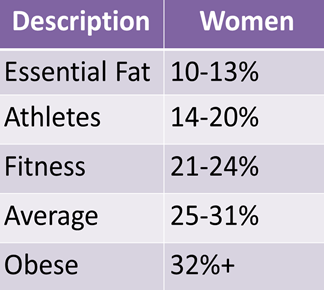 I’m ECSTATIC to say that since I started lifting consistently I’ve seen a couple major changes:
- I’m definitely burning more calories
- My massage therapist said my muscles have filled out
- I can see better definition in my shoulders
- My abdominal body fat is finally dropping
If you want to learn more about what I recommend for strength training for runners, you should check out my complete strength training guide.
Interestingly, all of these women are right around 130 lbs, but look very different.
All of them are beautiful with their different body shapes and physiques. They also prove that the scale needs to be just one measurement health. And yes that’s Beyoncé and Katy Perry in the mix because they are real women and role models I wanted to include them. A scale isn’t a bad tool and I definitely still step on mine occasionally as I go through training cycles or dietary changes, but after many years I finally understand it’s just one measurement and certainly doesn’t provide the whole picture.
Does Your Body Fat Percentage Matter?
Yes and No.
It all depends on your goals!
- If you feel amazing and your health is on track, then who cares?!
- If you’re working out and not seeing the scale budge, maybe this is a better metric.
- Do you need motivation to keep weight training (ME!!), this might help.
- Do you love how you look and how you perform? Doesn’t matter then!
- Have a friend who keeps wanting to drop pounds they shouldn’t? Muscle fitness progress might be a better gauge for them, so they can get strong and healthy vs being scale obsessed.
How to Measure Body Fat: Top Body Fat Measurement Tools
If you want to have a better idea about your body composition and get better health metrics, consider getting yourself a body fat measurement tool.
To figure out which one is best for you, let’s look at the top ones in more detail:
1. Body Mass Index (BMI)
Body Mass Index (BMI) is an old, unreliable measurement that doesn’t take into account things like body composition, ethnicity, race, gender, and age.
Despite its limitations, body mass index (BMI) is widely used by healthcare practitioners as a quick and inexpensive indicator of health status and potential outcomes. So I only mention it here because you need to know what it is in case someone shares a number with you.
BMI is used to determine whether you are a healthy weight. It is calculated by dividing weight in pounds (lbs) by height in inches squared and multiplying by a conversion factor of 703.

The greater the number, the more overweight a person is and the greater the associated health risks.
The benefit is that it is quick, simple, and inexpensive. There is a clear correlation between a higher body mass index and negative health consequences for most adults, so this does help. As with any weight measurement, you will need accurate scales and a measuring tape for height.
However, the main drawback of using BMI is that it cannot distinguish between weight from lean muscle and weight from fat. It doesn’t work well for people who are old, pregnant or have a lot of muscle.
2. Skinfold Calipers
Since the 1950s, body fat has been estimated using skinfold measurements.
Skinfold calipers measure the thickness of subcutaneous fat, or fat beneath the skin, at specific body locations.
This method, according to the American Council on Exercise, produces accurate results. Calipers are used to measure the thickness of skinfolds.
Men and women have different body fat distribution patterns, and so different areas are measurement for both to measurement body fat.
It is recommended that men measure their skinfolds on their chest, thighs, and abdomen.
For women, the skinfolds should be measured on the triceps, the thigh, and just above the hip bone. It’s crucial that measurements be taken in the exact same places every time. Then, individuals can input their measurements into an online calculator that estimates their body fat percentage.
Skinfold calipers are very cheap, and it doesn’t take long to take measurements with them. They’re convenient for use at home and on the go.
But how accurate the test is depends on how good the person doing the test is.
3. Bioelectrical Impedance Analysis (BIA)
BIA devices measure how your body reacts to minor electrical currents. This is accomplished by applying electrodes to your skin or by using a body scale that sends electrical currents and measures their rate of travel through your body.
Some devices send currents into your body, while others detect the signal after it has passed through your body’s tissues.
Due to the higher water content of muscle than fat, electrical currents pass through muscle more easily than through fat. Your body’s reaction to electrical currents is automatically entered by the BIA device into an equation that forecasts your body composition.
There is a wide range of BIA equipment available, and the prices, levels of complexity, and degrees of precision all differ significantly. In general, they are quick and simple, and users can purchase a variety of devices. They can also measure metrics other than body fat, such as fat free mass and even water.
The biggest drawback of body composition scales is that accuracy can be impacted by a user’s level of hydration.
Dehydration causes your body fat to be overestimated and y our body fat will be underestimated if you are dehydrated. Other types of water weight, such as swelling in the lower legs, can also cause readings to be off.
Plus, accuracy depends on the sensitivity of the particular scale you’re using, so more expensive instruments used in research and medical settings are more accurate than those made for home use.
4. Hydrostatic Weighing
Hydrostatic weighing, also known as underwater weighing or hydrodensitometry, uses density to calculate your body composition.
Using this method, you are weighed while underwater after exhaling as much air as you can. On dry land, your weight is also recorded, and the volume of air in your lungs after an exhalation is calculated or measured.
To calculate your body’s density, all of this data is put into equations. The density of your body is then used to predict your body fat percentage.
This method is among the most precise available. Consistent results indicate that it is a dependable method of measuring progress.
However, for some people, being completely submerged in water is difficult or impossible. The technique entails holding your breath underwater while exhaling as much air as you can. This is why this method may not be ideal for kids or the elderly.
Additionally, hydrostatic weighing is usually only accessible at universities, medical facilities, or specific fitness centers, making it inaccessible to most people. And when it is available, getting your body fat assessed can sometimes cost up to $100.
5. Air Displacement Plethysmography (Bod Pod)
Air displacement plethysmography (ADP), like hydrostatic weighing, determines your body’s density as a basis for estimating your body fat percentage.
However, ADP utilizes air rather than water. This device can estimate your body’s density based on the relationship between air pressure and volume.

You sit for a few minutes in an egg-shaped chamber while the air pressure inside the chamber changes.
It is recommended that you wear a bathing suit or other form of skin-tight clothing during testing to ensure precise measurements.
The method is precise, reasonably quick, and does not require submersion in water.
The Bod Pod is the primary ADP device in use today. It works well, but you can usually only get it at certain medical, research, or fitness centers. Plus, like hydrostatic weighing this method can also be pricey.
6. DEXA (Dual Energy X-ray Absorptiometry)
The DEXA scan is most commonly used to determine bone density, but it can also be used to determine body composition as well. To get measured, you are asked to remain motionless on a table as a machine arm passes over your entire body, emitting a high and low-energy X-ray beam.
It is regarded as the industry benchmark for calculating body composition.
Technicians can obtain readings for bone mineral density, lean body mass, and fat mass by measuring the absorption of each beam into different parts of the body.
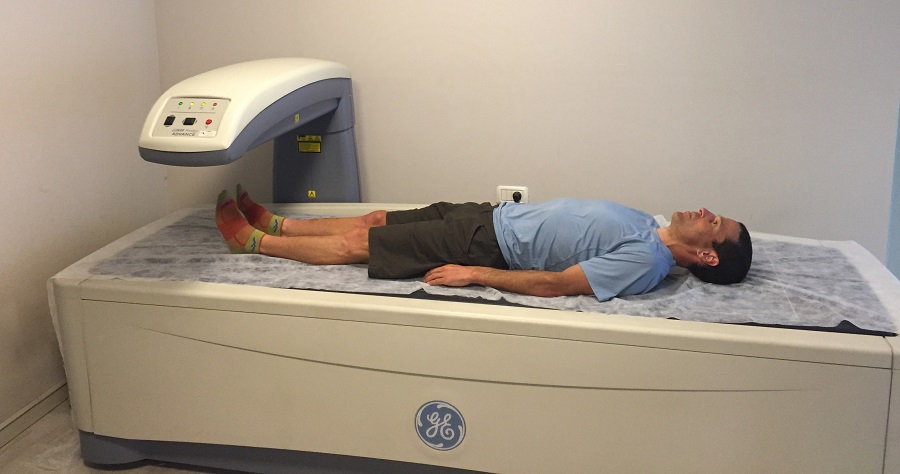
This method is safe, precise, dependable, and quick, taking approximately 4 minutes. It is regarded as the gold standard for determining body composition since I t not only tells you how much fat you have but also how it is distributed throughout your body.
However, the high level of precision comes at a cost. A single scan can cost $100 or more and is not available everywhere.
Best at Home Body Fat Measurement Tools
Now that we’ve covered the top body fat measurement tools, let’s look at the top three tools you can buy to measure body fat at home.
While these may not be as accurate as getting a professional DEXA scan or hydrostatic weighing, they are a great way to see trends over time to give you a sense of your general health and well-being.
You also have the option of getting professionally measured and then comparing it to your home device to see the margin of error, and then using that as an estimate to know what your approximate body fat percentage is over time.
However, do note that since your level of hydration can affect measurements, this still might not be a 100% accurate.
But keeping this in mind, let’s look at the top three tools I recommend you check out:
1. Accu-Measure Body Fat Calipers
If you’re interested in getting your hands on some good skinfold calipers, then this one by Accu-Measure is the one you need. It’s especially good if you have a friend, family member, or trainer that can help you measure since it’s trickier to do this by yourself.
It’s lightweight, portable, and a great pair of calipers. They’re one of the most recommended ones on the market and are even endorsed by the World Natural Bodybuilding Federation.
2. Withings Body+ Smart Wi-Fi Bathroom Scale
This fat-monitoring scale is great for the tech-savvy user in search of goal-setting support and personal accountability.
It uses bioelectric impedance to measure and analyze your body composition. It can store information about up to eight people and knows who they are when they step on the scale.
Plus, it works with the Health Mate app, which keeps track of all your health data over time so you don’t have to write anything down by hand.
Connecting to the app and setting up the scale is simple and straightforward, and the app contains a vast number of special features for those who want to delve deeply into their health.
While the actual measurement of body fat from one of these scales is usually wrong, if this is the method that you will use consistently then it still works because you can at least see if you are making progress downward with the body fat present.
3. Bello Body Fat Scanner
This handheld device is great for seeing your progress consistently either per muscle or for total body fat. If you’re like me and have calves of steel, but keep wondering why your abs don’t look the same you can just focus on one area for measurement.
In fact, there is some real science behind this nifty tool!

When applied to the skin, a very weak current passes between the outer two electrodes. This current is high-frequency and alternating in nature. As the current moves through the skin, the subcutaneous fat, and the muscle, it loses a little bit of energy due to the resistance of the tissue and this change is then measured by the two inner electrodes.
The Bello is more complex in that it measures electrical current flow in different directions and it can measure the flow at different depths (the further apart the electrodes, the deeper the electrical current will penetrate)
Read more:
How not to lose muscle mass while marathon training
How many calories do runners really need
5 best ways to measure body fat from Daily Burn
Why Body Mass Index is Wrong for so many by Huffington Post
Other ways to connect with Amanda
Instagram Daily Fun: RunToTheFinish
Facebook Community Chatter: RunToTheFinish
Get more running tips: Pinterest



 How to Make a Green Smoothie (Ultimate Beginner’s Guide)
Leave a Reply